



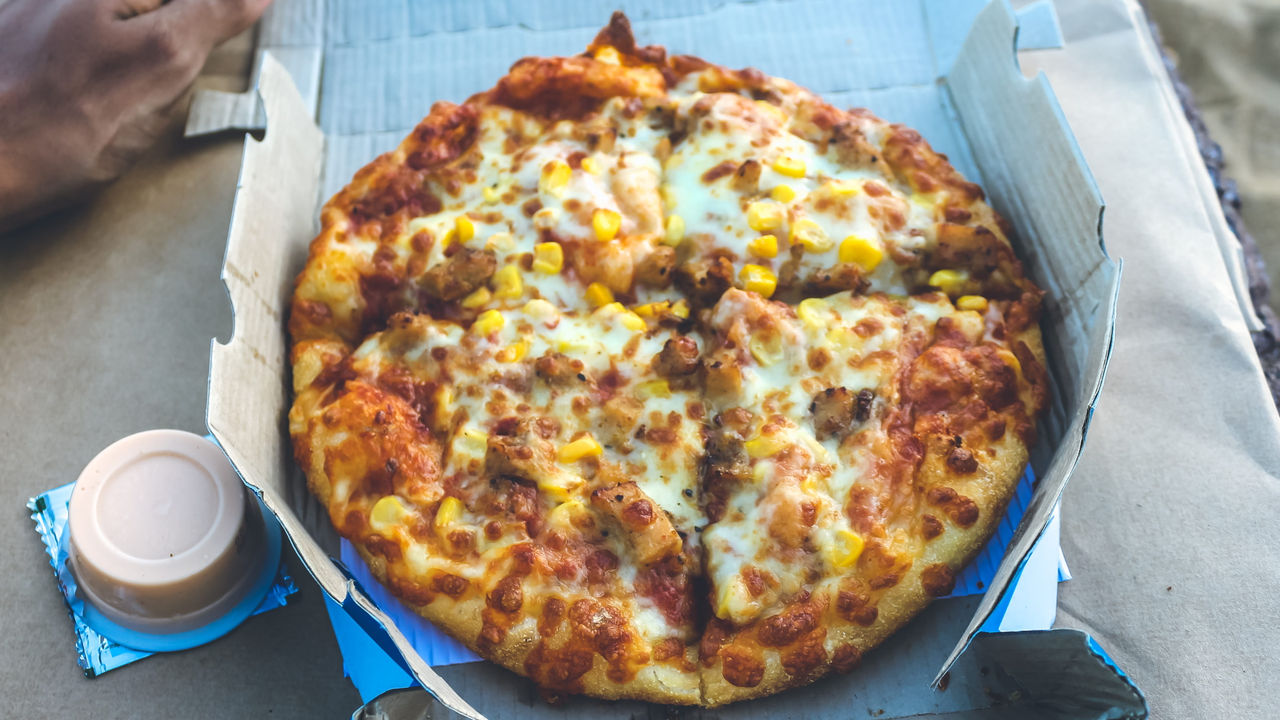
Domino’s has built its business around a pleasing bargain where dinner preparation becomes somebody else’s problem. Behind the reassuring familiarity of the blue box, however, growth is becoming harder to deliver. Customers are still ordering, but the pace of increase has slowed, offering the wider takeaway trade an unwelcome glimpse of what may lie ahead.
For operators competing for the same evening’s spending, the implication deserves attention. When the market leader finds the next order harder to win, financial strength becomes a more consequential advantage.
Plimsoll’s Pizza Restaurants & Shops Industry Analysis reveals how unevenly that strength is distributed. Some businesses have the means to adapt. Others are entering a more demanding market with precious little left to absorb the strain.
A slower rise at the market leader
As AJ Bell reported on 21 October, Domino’s Pizza Group, the UK and Ireland master franchise holder, recorded third-quarter like-for-like order growth of 1.4%, down from 2.2% in the previous quarter. Like-for-like sales growth eased from 5.2% to 2.3%.
Higher spending per transaction can lift sales; orders reveal how often customers choose to buy. Both measures remained ahead of the previous year, but the rate of improvement had diminished.
A single company’s quarterly figures cannot speak for every neighbourhood takeaway. Even so, slowing order growth at a business with Domino’s reach suggests that additional demand is becoming harder to secure. Smaller competitors have reason to examine their own resilience.
Domino’s retained its full-year earnings expectations, with major cost categories fixed for 2026 and into 2027. That certainty gives management something valuable: time to respond without every decision being overtaken by the next bill.
The industry is stretched thin
Across the 219 leading UK companies in Plimsoll’s Pizza Restaurants & Shops Industry Analysis, average sales growth stands at 1.7%, while average profitability is just 0.3%. Drawn from company accounts, these figures offer a broader financial perspective alongside Domino’s quarterly results, covering different periods and measures
At a hypothetical 0.3% margin, a business earns £3 of profit from £1,000 of sales. An additional £3 of costs, with everything else unchanged, erases the return. There is barely a crust of protection against disappointment.
The kitchen cannot wait for certainty. Ovens must be heated before the orders arrive, and wages fall due whether Friday evening brings a queue or a long acquaintance with the delivery screen.
A business with dependable earnings and manageable borrowing has room to endure a quieter spell. An operator already struggling to cover its commitments may have to make hurried decisions about prices, staffing or investment.
The slowdown therefore falls on businesses with very different capacities to withstand it. What one can accommodate, another may struggle to survive.
When a meal deal becomes an expensive habit
Plimsoll's Industry Analysis identifies 98 companies as being in financial danger, almost 45% of those analysed. Its analysis also records 54 businesses making losses for a second consecutive year. These groups may overlap; the danger rating signals vulnerability rather than an inevitable closure.
For an operator carrying repeated losses, the pursuit of another order becomes uncomfortable. Raising prices risks testing the customer’s loyalty. Lowering them risks exhausting the business’s own reserves.
Promotions can make commercial sense when they attract worthwhile additional trade. The difficulty begins when the offer reaches someone who would have ordered anyway. The kitchen does the same work, the customer enjoys a saving, and the operator finances the generosity.
A busy evening can consequently provide a misleading sense of reassurance. Orders are moving, but the money retained from them may be too little to replenish what the business has already spent.
Copying a competitor’s discount without understanding its finances compounds the uncertainty. That rival may have the resources to sustain the offer, or may be quietly making matters worse. Neither possibility appears on the leaflet.
Financial strength leaves room to respond
The industry’s averages conceal considerable differences. Plimsoll’s Industry Analysis records 100 companies with rising sales and 85 selling less than a year earlier, while identifying 92 among the strongest profit performers.
For owners, those differences offer a more useful starting point than the general impression that everyone is finding trade difficult. The relevant comparison is with businesses that turn demand into dependable earnings and retain the capacity to invest.
Plimsoll’s individual company assessments examine profitability, debt and the use of resources. They help distinguish growth supported by sound finances from expansion that places a business under increasing strain. They also give owners a clearer view of which competitors can sustain their approach when conditions become less favourable.
That strength has practical consequences. It can fund equipment replacement before a breakdown forces the issue, or allow a new product time to find its customers. It gives an owner more freedom to choose.
Domino’s reported support from its Italianos pizzas and Chick ’N’ Dip range. Smaller operators will have their own opportunities, provided their ambitions stay within the business's means. An appealing menu addition still needs a sound financial base.
Knowing who can take the heat
Plimsoll also rates 61 companies as highly attractive acquisition targets. For operators with the capacity to invest, a more demanding market may offer opportunities to strengthen their position. The rating invites closer examination; it does not establish that a company is for sale.
The essential discipline is the same for a prospective buyer and an existing owner. Look beyond the shopfront. Compare financial performance with relevant peers, scrutinise borrowing and test current cash-flow forecasts against a quieter period. Historical accounts establish the starting position; forecasts explore how much pressure it can bear.
Domino’s slowing order growth points to a tougher contest for the takeaway customer. Plimsoll’s Pizza Restaurants & Shops analysis helps identify the operators equipped to compete without weakening themselves in the process.
There will still be appetites to satisfy and good businesses serving them. Financial strength gives those businesses the chance to keep improving, even when growth becomes harder to deliver. The next order matters. So does having enough left from it to face tomorrow.