



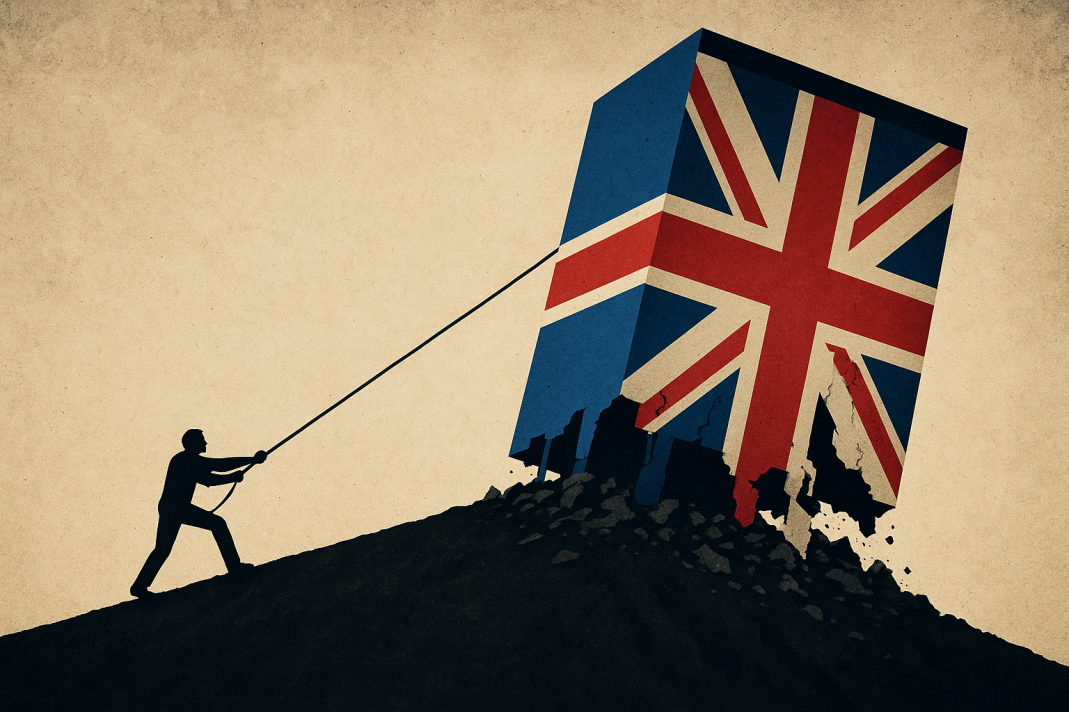
More than a third of British businesses are financially in trouble, and the problem is growing faster inside the UK's largest companies than almost anywhere else.
The latest Plimsoll analysis, drawn from five years of filed accounts at Companies House, rates 38% of British businesses as being in financial Danger, up from 34% the year before. Behind that single number is a more uncomfortable story: size is no longer a safety net. Among UK firms holding £50 million or more in assets, the Danger rate climbs to 41%. The companies most people assume are too big to fail are, in fact, over-represented among those closest to it.
If you sell to, buy from, lend to, or compete with UK Plc, this is the risk picture you need to understand heading into 2026.
What "in financial trouble" actually means
"In financial trouble" is an easy phrase to throw around. At Plimsoll, it has a specific, testable meaning.
Every company on our database is rated on a five-point scale: Strong, Good, Mediocre, Caution, Danger. The rating is produced by the Plimsoll Model, a standardised analysis, built on five years of audited accounts, that asks four simple questions of any business:
- Is it generating enough sales and profit from the assets it owns?
- Is it properly capitalised, or leaning too hard on its creditors?
- Is it over-leveraged?
- Do its performance trends leave it exposed if conditions worsen?
A "Danger" rating is not a prediction of imminent collapse. It is an early warning that the underlying financial structure of the business has weakened to the point where it cannot easily absorb a shock, a lost contract, a supplier failure, a rate change, a quiet quarter.
The track record matters here. Nine out of ten companies that ultimately entered administration were rated Danger by Plimsoll up to two years before their demise. That lead time is the point. It turns distress from a surprise into a manageable risk.
The scale of the problem: 1 in 3...and rising
The headline figure is stark. Of the thousands of UK companies analysed in the latest cycle:
- 38% are rated Danger (up 4 percentage points year-on-year)
- 48% are rated Strong, steady against last year
- The middle tiers, Good, Mediocre, Caution, are being hollowed out, with businesses migrating downward rather than upward
The shape of that distribution is important. The UK economy is not gently softening; it is polarising. Resilient companies are holding their ground. Weaker companies are deteriorating faster. There is less of a middle than there used to be.
Why big doesn't mean safe
Perhaps the most counter-intuitive finding is what is happening at the top of the market.
Among British businesses with more than £50 million in assets, the share rated in Danger stands at 41%, higher than the all-company average. Heavy fixed cost bases, legacy capital structures, and slow-to-pivot operating models have left several of the UK's best-known names more exposed than their smaller, leaner peers.
For acquirers, investors, and supply chain teams, that has a practical consequence: you cannot screen for risk by size alone. A £500m turnover counterparty is not automatically safer than a £20m one. It needs to be rated on its numbers, not its reputation.
What "Strong" companies are doing differently
The other side of the same dataset is the 48% of British businesses still rated Strong. Three patterns show up repeatedly in their accounts:
- Disciplined working capital. Receivables, payables, and inventory are managed tightly, cash is not trapped inside the business.
- Sensible leverage. Debt is used, but not relied on. When rates moved, these firms felt it; they didn't buckle under it.
- Productive assets. Every pound of plant, stock, and goodwill on the balance sheet is pulling its weight in revenue and margin.
None of this is glamorous. All of it is visible in filed accounts, which is precisely why the Plimsoll Model can surface it before the market does.
What this means if you work with UK companiesThe practical implications of the current risk picture depend on your seat at the table:
- If you sell to UK businesses, roughly one in three of the companies on your prospect list is running on weakened fundamentals. Pipeline qualification now needs a financial health lens, not just a fit-and-intent lens.
- If you buy from UK suppliers, supplier failure is a rising operational risk. A single Danger-rated supplier in a critical category can stall a product line.
- If you're looking at acquisitions, the combination of polarised performance and exposed big-balance-sheet firms is creating genuine opportunity, but only for buyers who can read the signals early.
- If you are a UK business, the question is simpler and more personal: what does our own Plimsoll rating look like, and what is it doing to our ability to win deals, raise finance, and recruit?
Spot trouble before the market does
The Plimsoll Model has been giving early warning of business failure since 1987. In a year when more than a third of British businesses are financially in trouble and the largest firms are disproportionately exposed, the value of that early warning has rarely been higher.
Next step: Check the Plimsoll rating of any UK company · Browse industry reports by sector · Talk to our analyst team